When a CI run fails, re-running the entire job wastes time on tests that have already passed. This workflow runs only the failed tests on subsequent attempts.
ExampleYour test suite has 500 E2E tests.
  • A full run takes 1 hour
  • 50 tests fail and take about 6 minutes to run
Re-running the entire suite means executing 450 passing tests again. With this approach, only the 50 failed tests are re-run.Result: You save approximately 54 minutes per re-run.
ScenarioFull suite rerun timeFailed only rerun timeTime savedCost saved on LinuxCost saved on WindowsCost saved on macOS
Per rerun60 min6 min54 min$0.324$0.54$3.348
Per day (10 reruns)600 min60 min540 min (9 hrs)$3.24$5.40$33.48
Per 30-day month (10 reruns daily)18,000 min1,800 min16,200 min (270 hrs)$97.20$162.00$1,004.40
Note: Pricing is based on GitHub’s official Actions runner pricingfor GitHub-hosted runners:
  • Linux (2-core): $0.006 per minute
  • Windows (2-core): $0.010 per minute
  • macOS: $0.062 per minute
This guide covers:
  • Sharded Playwright execution
  • Re-run failed jobs in GitHub Actions
  • Failed-tests-only re-runs when failure metadata exists
  • Full-suite fallback when no test metadata exists

Quick Reference

TaskCommand/ActionLink
Run full test suitenpx playwright test-
Cache failed test metadatanpx tdpw cacheSetting up cache
Get last failed testsnpx tdpw last-failedHow it works
Re-run detectionCheck github.run_attemptWorkflow logic
Upload HTML reportactions/upload-artifact@v4Quick start

How it works

This workflow uses two TestDino CLI commands:
  • npx tdpw cache stores failed test metadata after a run
  • npx tdpw last-failed returns Playwright arguments for the last failed tests
The workflow detects re-runs using github.run_attempt:
ConditionBehavior
run_attempt = 1Run full test suite
run_attempt > 1, flags foundRun failed tests only
run_attempt > 1, no flagsRun full test suite (fallback)
Playwright compatibility: Since @playwright/test@1.50+, Playwright has native --last-failed support. TestDino extends this with cross-runner caching, shard awareness, and workflow-level persistence.

Quick start

Add this logic to your Playwright step:
- name: Run Playwright with rerun logic
  env:
    TESTDINO_TOKEN: ${{ secrets.TESTDINO_TOKEN }}
  run: |
    echo "Run attempt: ${{ github.run_attempt }}"
    if [[ "${{ github.run_attempt }}" -gt 1 ]]; then
      npx tdpw last-failed > flags.txt
      FLAGS="$(cat flags.txt)"
      if [[ -n "$FLAGS" ]]; then
        echo "Re-running only failed tests"
        eval "npx playwright test $FLAGS"
        exit 0
      fi
    fi
    echo "Running full test suite"
    npx playwright test

- name: Upload HTML report
  uses: actions/upload-artifact@v4
  with:
    name: Playwright Test Report
    path: ./playwright-report
    retention-days: 14

- name: Cache failed test metadata
  if: always()
  env:
    TESTDINO_TOKEN: ${{ secrets.TESTDINO_TOKEN }}
  run: npx tdpw cache
The cache step runs with the if: always() condition, so failures are recorded even when tests fail.
Need to set up your API token? See Generate API Keys for instructions.

How to re-run failed tests in GitHub Actions?

1

Open the failed job

In the GitHub Actions run, find the failed job for Playwright:
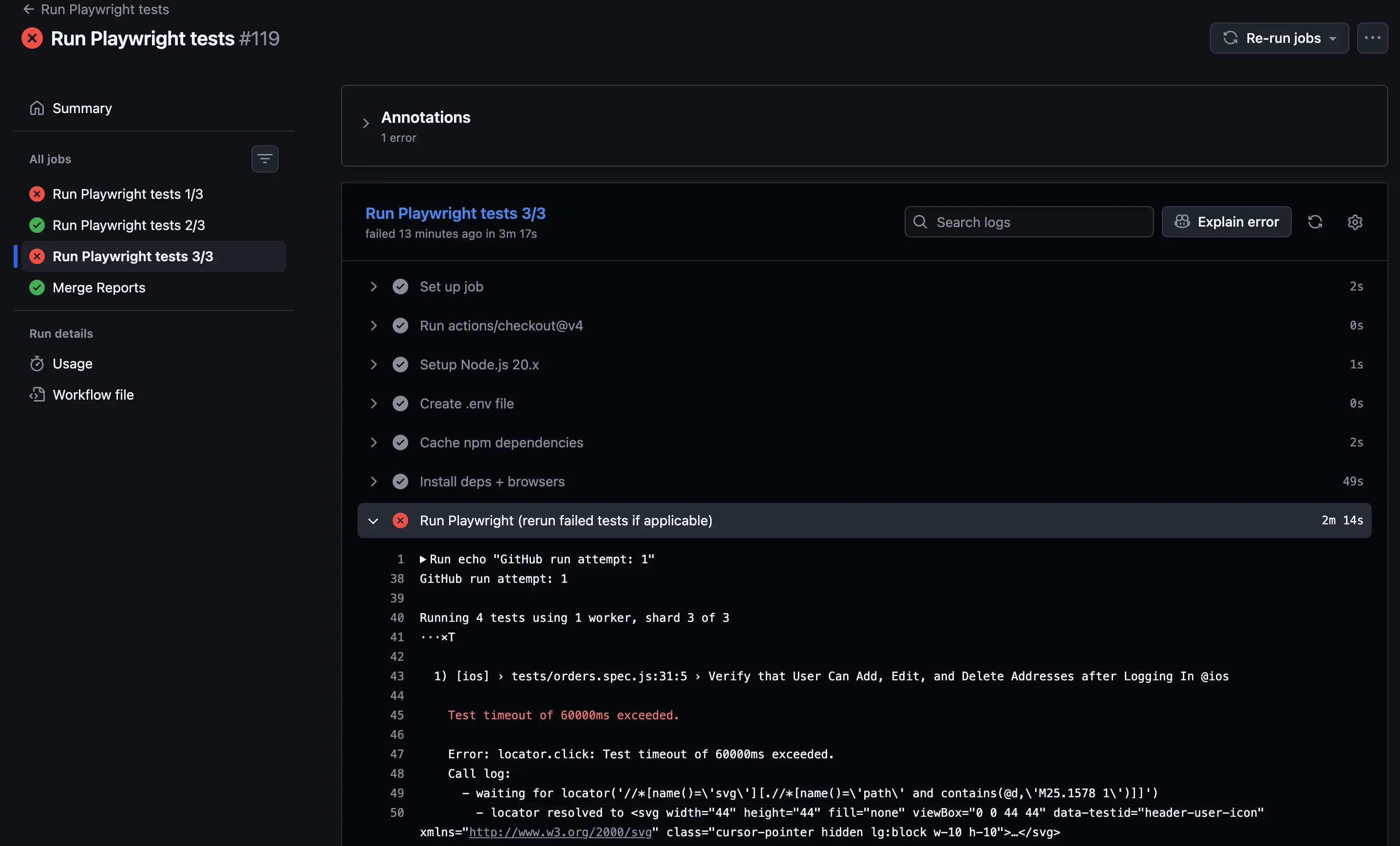
  1. Go to your GitHub repository’s Actions tab.
  2. Select the failed workflow run.
  3. Under Jobs, open the job where Playwright tests get executed & fail.
This is the main job that executes Playwright and sharding.
Step 1: Open failed job
2

Check the run attempt

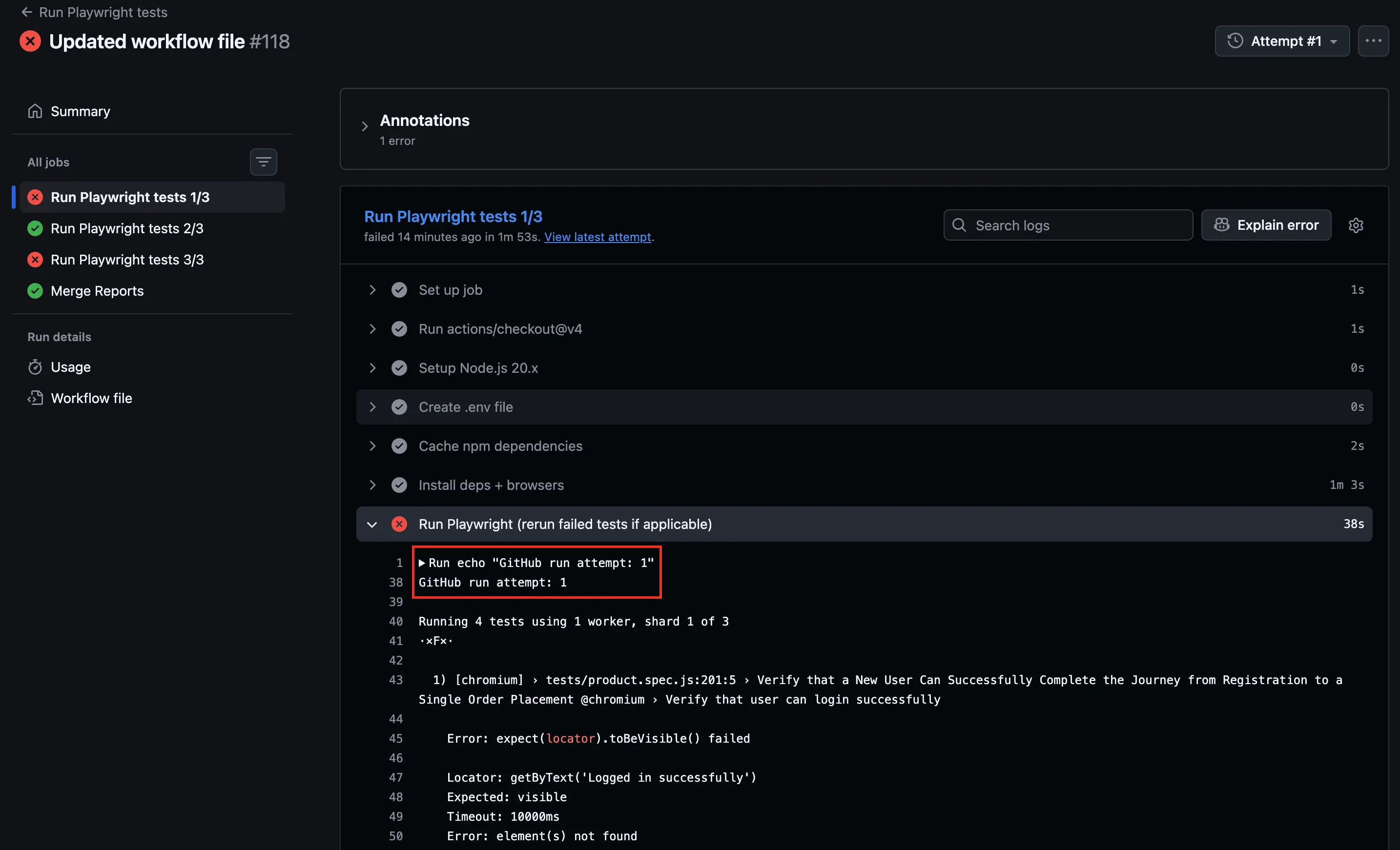
Inside the job, open the Playwright execution step. In the logs, you can see:
  • GitHub run attempt: <number>
  • Re-run detection output Step 2: Check run attempt
3

Identify the failed tests

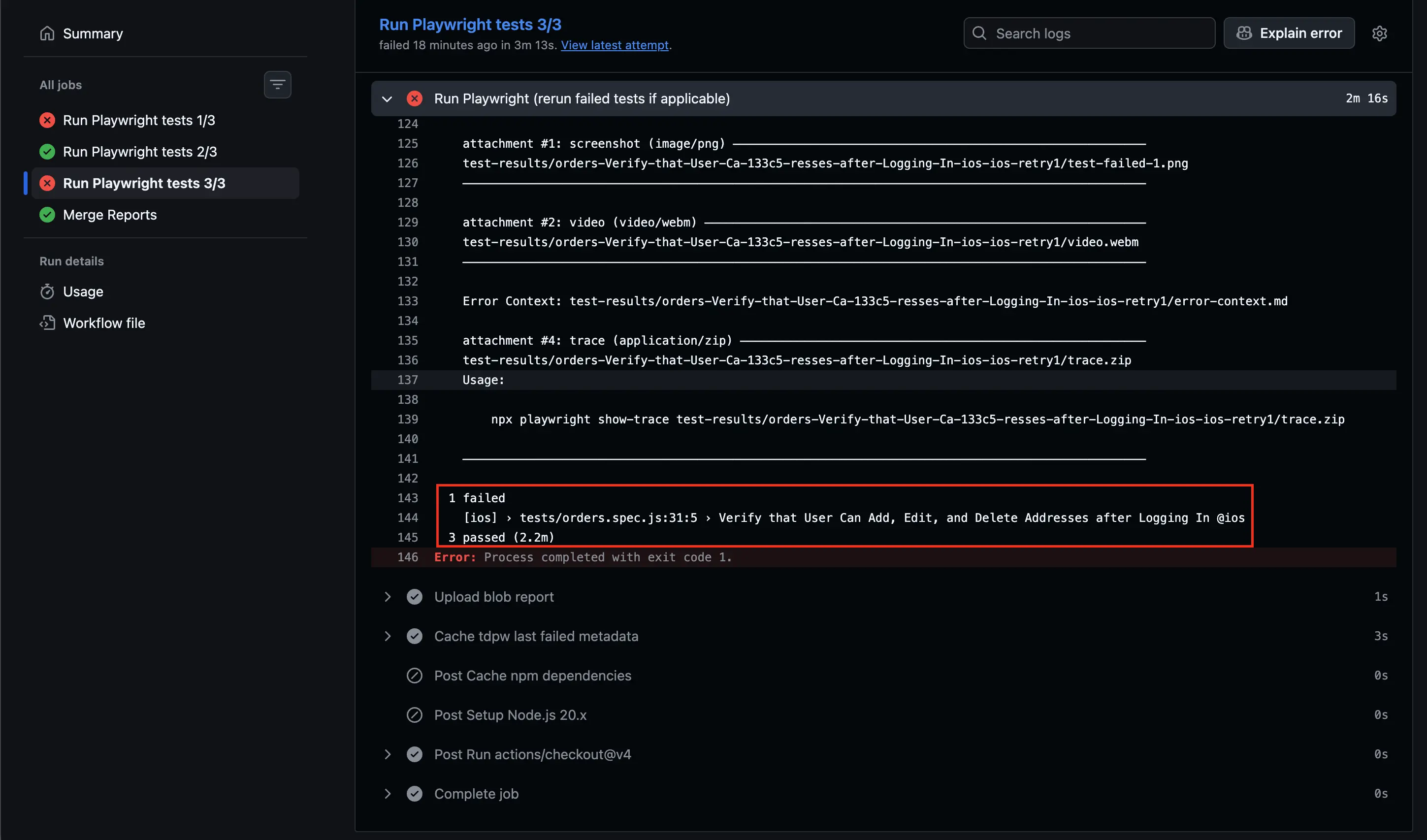
Scroll to the end of the Playwright output. GitHub Actions show:
  • Total failed test count
  • Failed test titles Step 3: Identify failed tests
4

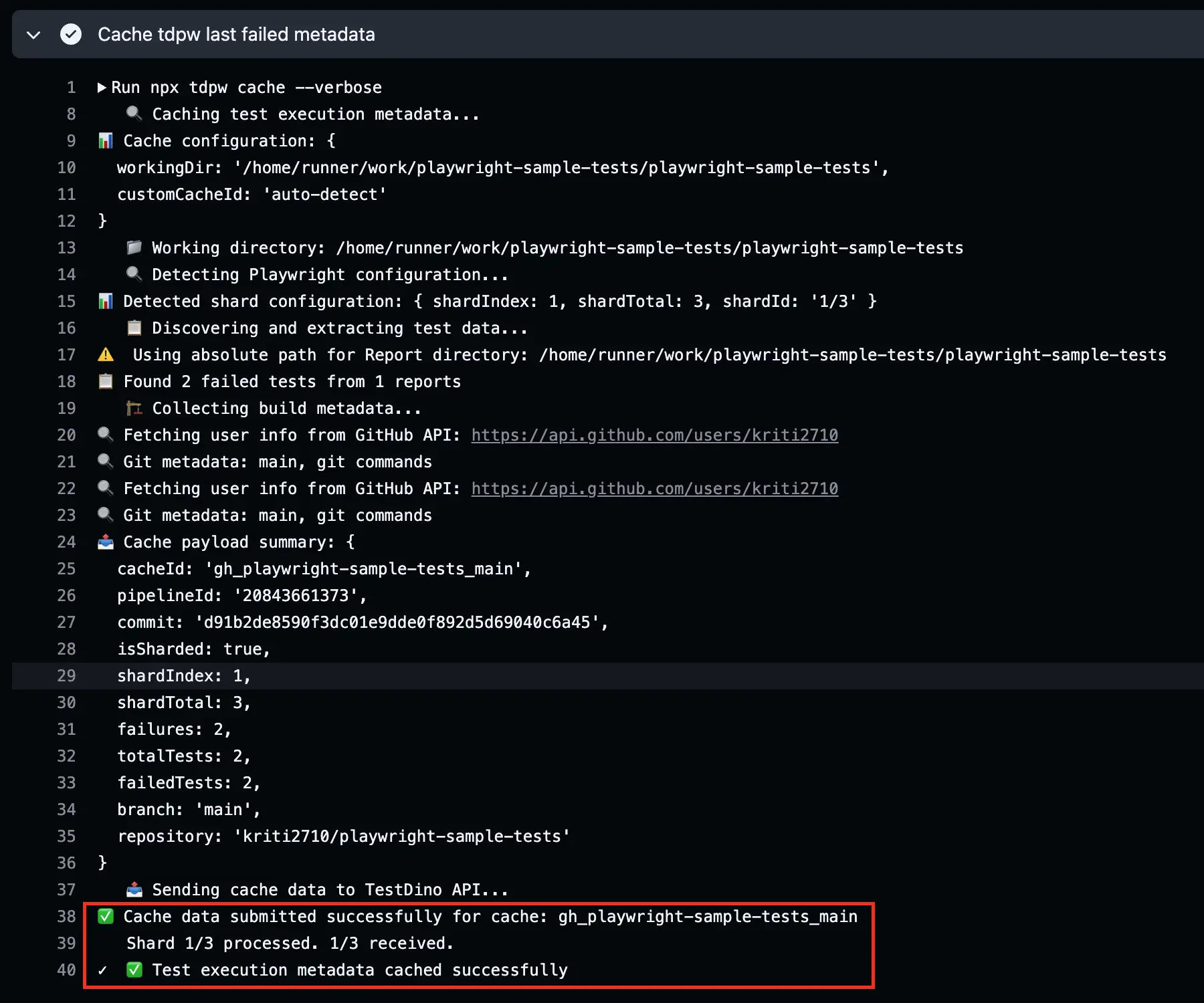
Confirm caching

Open the Cache failed test metadata step. Look for:
Cache data submitted successfully
This confirms TestDino stored the failure metadata.Step 4: Confirm caching
5

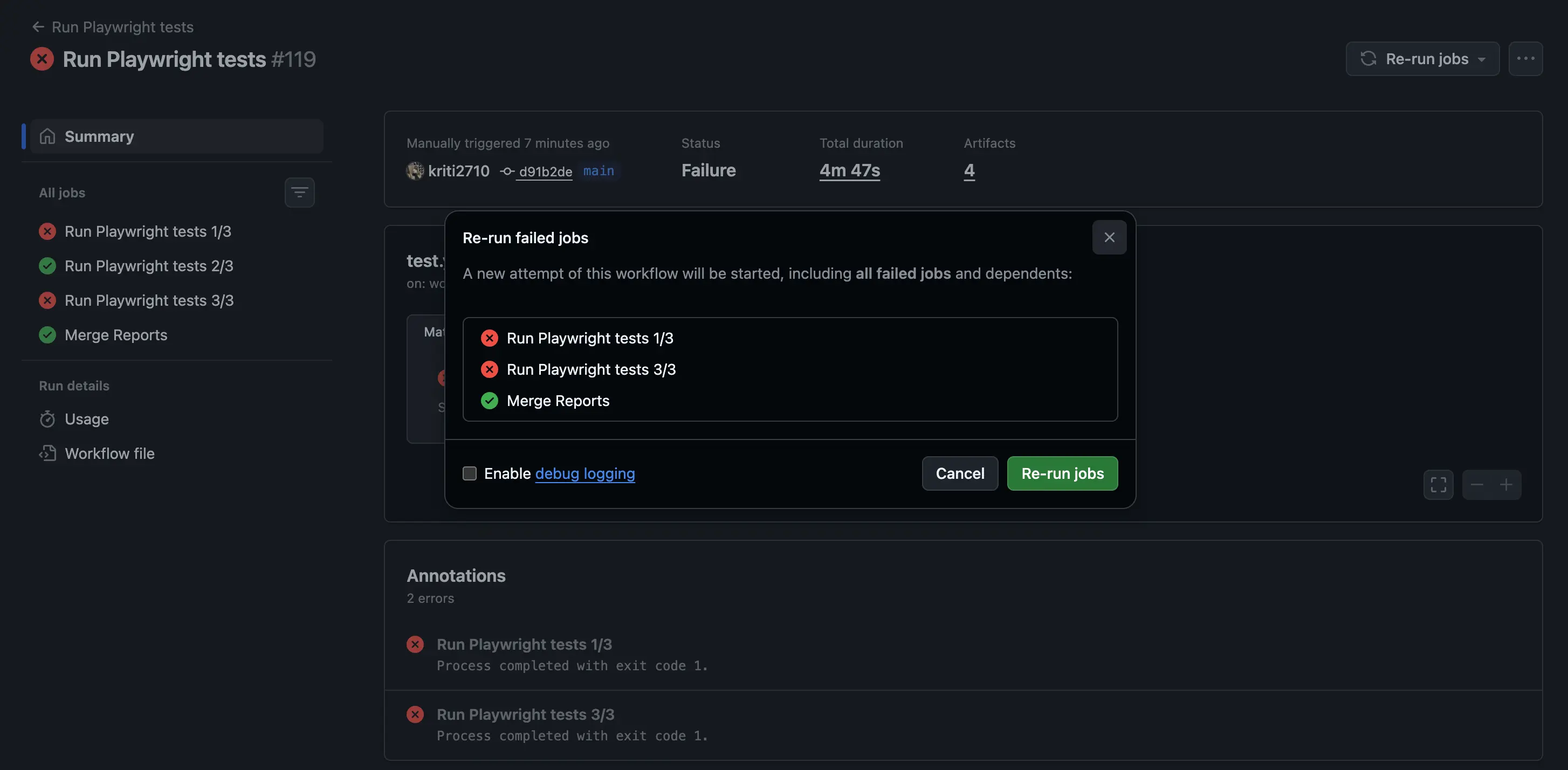
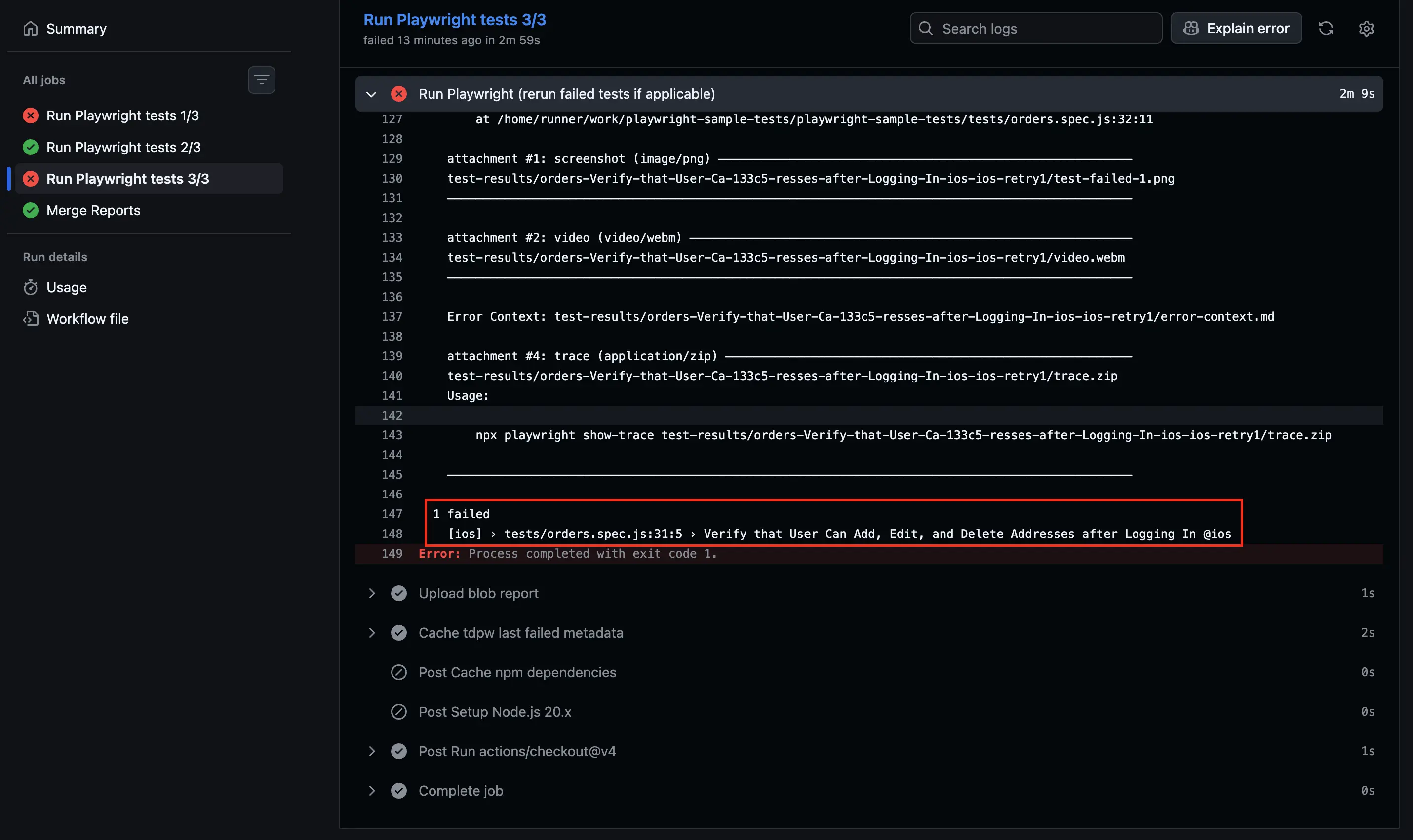
Confirm Re-run

Re-run the failed pipeline and confirm the execution of only the last failed tests.
  • The workflow detects run_attempt > 1
  • tdpw last-failed retrieves the failed tests
  • Only those tests are executed Step 5: Confirm re-run part 1 Step 5: Confirm re-run part 2
First run: 12 tests across 3 shards. Two shards fail.
ShardTestsResult
Shard 14 tests2 Passed, 2 Failed
Shard 24 testsPassed
Shard 34 tests3 Passed, 1 Failed
Re-run comparison:
├── Shard 1: runs 4 tests
├── Shard 3: runs 4 tests
└── Total: 12 tests
Re-runs all tests in failed shards, including tests that already passed.

Full workflow

For a complete workflow with sharding and report merging, see the example repository.
File name: .github/workflows/playwright.ymlRepository: github.com/testdino-hq/playwright-sample-tests-javascript
name: Run Playwright tests

on:
  push:
  pull_request:
  schedule:
    - cron: '30 3 * * 1-5' # 11:00 AM IST
  workflow_dispatch:

jobs:
  run-tests:
    name: Run Playwright tests ${{ matrix.shardIndex }}/3
    runs-on: ubuntu-latest

    strategy:
      fail-fast: false
      matrix:
        shardIndex: [1, 2, 3]
        shardTotal: [3]

    steps:
      - uses: actions/checkout@v4

      # ✅ REQUIRED: Node 20
      - name: Setup Node.js 20.x
        uses: actions/setup-node@v3
        with:
          node-version: '20'

      - name: Create .env file
        run: |
          echo "USERNAME=${{ secrets.USERNAME }}" >> .env
          echo "PASSWORD=${{ secrets.PASSWORD }}" >> .env
          echo "NEW_PASSWORD=${{ secrets.NEW_PASSWORD }}" >> .env
          echo "FIRST_NAME=${{ secrets.FIRST_NAME }}" >> .env
          echo "STREET_NAME=${{ secrets.STREET_NAME }}" >> .env
          echo "CITY=${{ secrets.CITY }}" >> .env
          echo "STATE=${{ secrets.STATE }}" >> .env
          echo "COUNTRY=${{ secrets.COUNTRY }}" >> .env
          echo "ZIP_CODE=${{ secrets.ZIP_CODE }}" >> .env

      - name: Cache npm dependencies
        uses: actions/cache@v3
        with:
          path: ~/.npm
          key: ${{ runner.os }}-node-${{ hashFiles('**/package-lock.json') }}
          restore-keys: |
            ${{ runner.os }}-node-

      - name: Install deps + browsers
        run: |
          npm ci
          npx playwright install --with-deps chromium firefox webkit

      # ✅ FULL + RERUN LOGIC
      - name: Run Playwright (rerun failed tests if applicable)
        env:
          TESTDINO_TOKEN: ${{ secrets.TESTDINO_TOKEN }}
          SHARD_INDEX: ${{ matrix.shardIndex }}
          SHARD_TOTAL: ${{ matrix.shardTotal }}
        run: |
          echo "GitHub run attempt: ${{ github.run_attempt }}"

          if [[ "${{ github.run_attempt }}" -gt 1 ]]; then
            echo "Detected re-run. Checking failed test metadata from TestDino."

            npx tdpw last-failed \
              --shard=${{ matrix.shardIndex }}/${{ matrix.shardTotal }} \
              > last-failed-flags.txt

            EXTRA_PW_FLAGS="$(cat last-failed-flags.txt)"

            if [[ -n "$EXTRA_PW_FLAGS" ]]; then
              echo "Running only failed tests for this shard:"
              echo "$EXTRA_PW_FLAGS"

              # IMPORTANT: JSON + BLOB BOTH REQUIRED
              # Ensure playwright-report directory exists
              mkdir -p ./playwright-report
              eval "npx playwright test $EXTRA_PW_FLAGS"
              exit 0
            fi

            echo "No failed test metadata found. Falling back to full shard."
          fi

          # First run (full shard)
          # Ensure playwright-report directory exists
          mkdir -p ./playwright-report
          npx playwright test \
            --grep="@chromium|@firefox|@webkit|@android|@ios" \
            --shard=${{ matrix.shardIndex }}/${{ matrix.shardTotal }}

      - name: Upload blob report
        if: ${{ !cancelled() }}
        uses: actions/upload-artifact@v4
        with:
          name: blob-report-${{ matrix.shardIndex }}
          path: ./blob-report
          retention-days: 1

      # ✅ THIS WILL SHOW "Metadata cached successfully ✔" WHEN JSON EXISTS
      - name: Cache tdpw last failed metadata
        if: always()
        env:
          TESTDINO_TOKEN: ${{ secrets.TESTDINO_TOKEN }}
          SHARD_INDEX: ${{ matrix.shardIndex }}
          SHARD_TOTAL: ${{ matrix.shardTotal }}
        run: |
          npx tdpw cache --verbose

  merge-reports:
    name: Merge Reports
    needs: run-tests
    if: always()
    runs-on: ubuntu-latest

    steps:
      - uses: actions/checkout@v4

      # ✅ Node 20 here as well
      - name: Setup Node.js 20.x
        uses: actions/setup-node@v3
        with:
          node-version: '20'

      - name: Cache npm dependencies
        uses: actions/cache@v3
        with:
          path: ~/.npm
          key: ${{ runner.os }}-node-${{ hashFiles('**/package-lock.json') }}
          restore-keys: |
            ${{ runner.os }}-node-

      - name: Install deps + browsers
        run: |
          npm ci
          npx playwright install --with-deps

      - name: Download all blob reports
        uses: actions/download-artifact@v4
        with:
          path: ./all-blob-reports
          pattern: blob-report-*
          merge-multiple: true

      - name: Merge HTML & JSON reports
        run: npx playwright merge-reports --config=playwright.config.js ./all-blob-reports

      - name: Upload combined report
        uses: actions/upload-artifact@v4
        with:
          name: Playwright Test Report
          path: ./playwright-report
          retention-days: 14

      - name: Send TestDino report
        run: |
          npx --yes tdpw ./playwright-report \
            --token="${{ secrets.TESTDINO_TOKEN }}" \
            --upload-html \
            --upload-traces \
            --verbose

How the workflow logic works

The workflow uses a conditional check based on github.run_attempt:
if [[ "${{ github.run_attempt }}" -gt 1 ]]; then
  # Re-run: get failed tests from TestDino
else
  # First run: execute full shard
fi
  • On the first attempt (run_attempt == 1), the full shard is executed.
  • On subsequent attempts, the workflow attempts to re-run only previously failed tests.
The tdpw last-failed command outputs test filters formatted for Playwright:
-g "Verify that a New User Can Successfully Complete the Journey from Registration to a Single Order Placement @chromium|test @chromium"
These flags can be passed directly to npx playwright test.
The command uses eval to handle quoted arguments in the test filter:
eval "npx playwright test $EXTRA_PW_FLAGS"
This keeps the -g "pattern" quoting intact when passed to Playwright.

Edge cases

If a job fails during dependency installation or setup, no test metadata exists.On re-run:
  1. tdpw last-failed returns nothing
  2. The workflow detects the empty result
  3. The job runs the full shard
No manual action required. The workflow handles this case automatically:
if [[ -n "$EXTRA_PW_FLAGS" ]]; then
  # Failed tests found, run only those
  eval "npx playwright test $EXTRA_PW_FLAGS"
else
  echo "No failed test metadata found."
  echo "Running full shard instead."
fi
And then, it will run the normal execution:
mkdir -p ./playwright-report
npx playwright test \
  --grep="@chromium|@firefox|@webkit|@android|@ios" \
  --shard=${{ matrix.shardIndex }}/${{ matrix.shardTotal }}
Playwright’s --max-failures option stops test execution after N failures. For example:
npx playwright test --max-failures=2
Playwright stops after 2 failures. Tests that did not run are not recorded.On re-run, only the failed tests execute. Skipped tests are not included as of now.
CI overview, GitHub Actions, status checks, and flaky tests.